Spin The Wheel Yes Or No
2 optionsRandom draw
Classic · Decisions
Ask one clear, low-stakes question and let two equally weighted answers break the tie. The first result is most useful when you agree not to keep spinning for the answer you wanted.
Ready to spin
2 optionsRandom draw
Updated August 12, 2026. The two stored entries and their displayed weights were checked to confirm that the untouched preset begins as an equal 50/50 choice. Source: editorial decision rule, checked August 12, 2026.
This is a tie-breaker for a question with two acceptable answers. It works well for “Should we play one more round?”, “Do we use the blue layout?”, or “Do I cook at home tonight?” when either outcome is safe and the people involved are willing to accept a random nudge. It is less useful when the real answer depends on missing facts. A wheel can end hesitation; it cannot turn an unclear problem into a good decision.
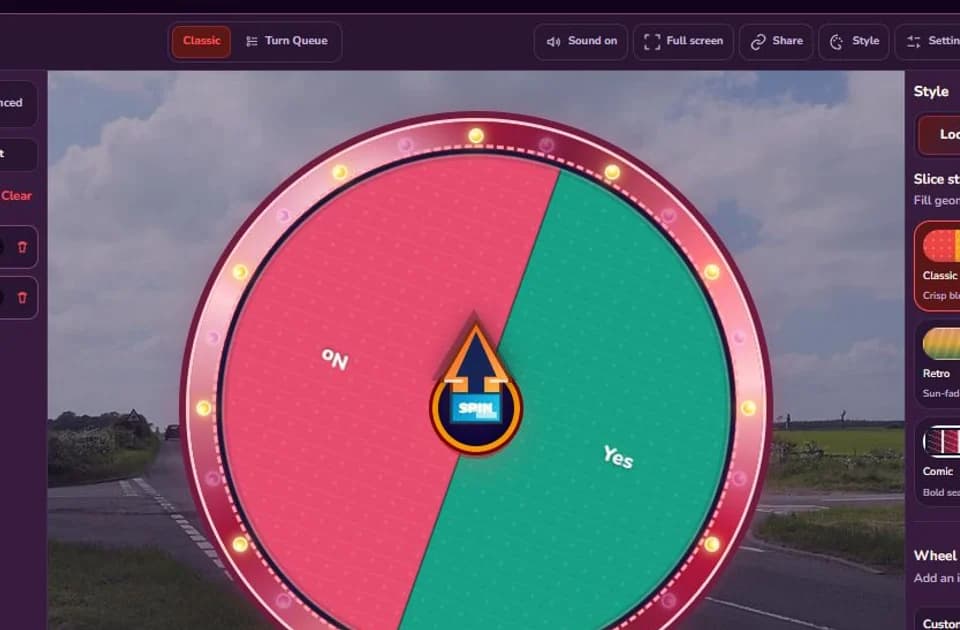
Yes and No each occupy one of two equally weighted slices, so the displayed chance begins at 50% per answer. Advanced can change weights, but then the page is no longer a fair yes-or-no coin flip. Check the percentages before sharing the wheel, especially if someone else has edited the preset. Slice size and the result are produced from those stored weights; background artwork does not create extra entries or improve an option's chance.
A useful question is specific, time-bounded, and understood the same way by everyone. “Should we go?” hides the destination, timing, cost, and who “we” includes. “Should our group walk to the café across the street now?” gives Yes and No a stable meaning. Avoid double negatives such as “Shouldn't we not cancel?” and do not spin until the affected people agree that both labels are genuine options.
Ask the question aloud, confirm the two equal percentages, and spin once. Repeating the spin until Yes appears is a preference test disguised as chance. That reaction can still be useful: if the first result disappoints you immediately, you may already know what you want. In that case, stop using the wheel and discuss the preference rather than pretending a later spin is more valid.
For a neutral action choice, rename the slices to “Do it” and “Skip it.” For a turn decision, use two player or team names. For an A/B design review, use the actual variant names so Results remains meaningful later. If there are three honest outcomes—Yes, No, and Ask later—add the third option and update the page title when sharing; it is no longer a 50/50 yes-or-no wheel.
A coin is faster for one person. This wheel is stronger when a group needs to see the question, check equal odds, use Full screen, keep the selected answer in Results, or share the exact two-option setup. The large labels also make remote calls easier to follow. Those are transparency and presentation benefits, not a claim that the wheel makes wiser choices.
Do not use Spin The Wheel Yes Or No for medical treatment, personal safety, consent, legal action, financial commitments, employment decisions, or anything that can materially harm another person. Get appropriate information or professional advice. Randomness belongs at the end of a low-stakes tie, not at the beginning of a high-stakes judgment.
Tell me what should go on the wheel, which mode it needs, and how you would use it.