Country Spin The Wheel
24 optionsRandom draw
Classic · Geography
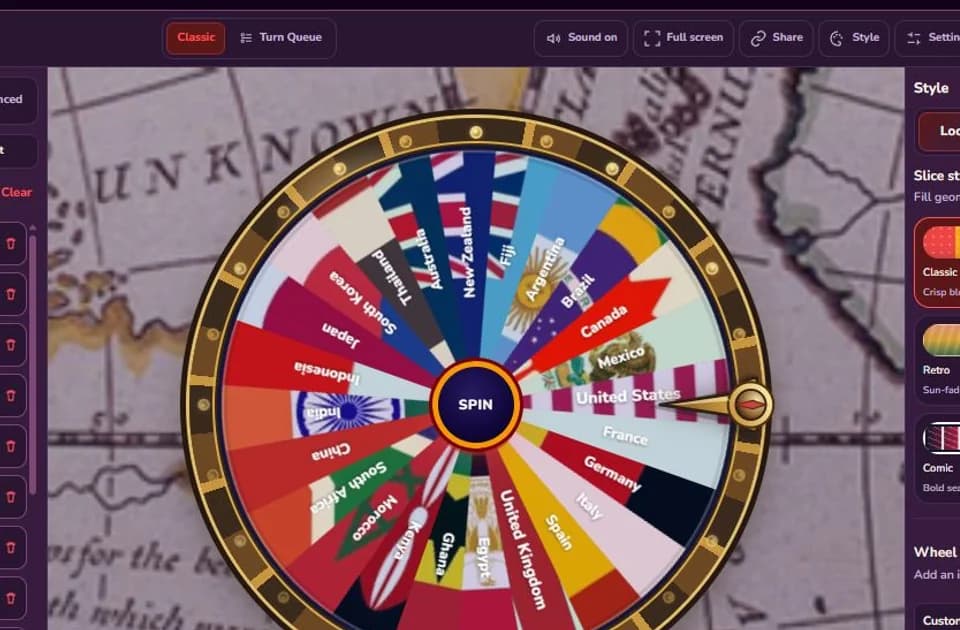
Spin a balanced 24-country starter set drawn from every inhabited region. Use the result for geography prompts, trivia, food themes, or early travel research.
Ready to spin
24 optionsRandom draw
Updated August 12, 2026. The 24-country sampler was counted across five broad M49 regions, then every visible flag background was matched to its country label. Source: UN Statistics M49 country and region names, checked August 12, 2026.
This page deliberately does not squeeze every country and area onto one disc. It uses 24 familiar country names as an editable starter set spanning five broad M49 regions. The smaller pool keeps labels and flags usable in a classroom, party, or quick research prompt while making the selection scope easy to explain.
| Broad region | Starter entries | Examples |
|---|---|---|
| Americas | 5 | Argentina, Canada, Mexico |
| Europe | 5 | France, Germany, Italy |
| Africa | 5 | Egypt, Ghana, Kenya |
| Asia | 6 | China, India, Thailand |
| Oceania | 3 | Australia, Fiji, New Zealand |
The counts describe this editorial set, not the number of countries in each region. Use the Europe Country Wheel for its separate 44-state, explicitly scoped European list.
A country name alone teaches very little. After a spin, ask the player to locate it on a map and investigate four dated facts: capital, M49 subregion, one physical-geography feature, and one language using a reliable source. Add a comparison question—“How does its climate or population distribution differ from the previous result?”—to move beyond isolated trivia.
A random country should open research, not invite an accent imitation or a claim that millions of people share one personality, religion, or custom.
Replace the sampler with the countries covered by the unit, then switch Remove winner on. Show the final eligible count before spinning once per student or team. Results becomes the assignment ledger and can be exported. If source availability or a learner's needs make one assignment difficult, publish a swap process instead of improvising exceptions after results appear.
For a theme night, let the result choose what to research, not what to represent as definitive. Countries contain regional and community differences. For travel, verify visas, official safety advice, seasons, transport, accessibility, and cost before spending money. The wheel cannot know where the user lives or which entry rules apply.
A full-world wheel looks comprehensive but produces extremely narrow slices and a long editing job. This starter gives one visible, inspectable pool with flags behind the labels. Users can add a class syllabus through Import, use Advanced to correct one image or label, remove winners for allocation, and download Results. The result is easier to read and the scope is harder to misunderstand.
The baseline names and broad regional references use the UN Statistics M49 standard, which exists for statistical use. M49 states that its regional assignment does not decide political or other affiliation. If your organization uses a different geographic or recognition policy, edit the options and state that policy next to the activity.
Tell me what should go on the wheel, which mode it needs, and how you would use it.